EMT Practice Test

1. Question Content...


Question List

Question1: Refer to the exhibit to the right.

What is the primary key of ACCOUNT_TRANS?

Question2: A customer has a set of date values in different formats.
Some dates are in Julian date format; some dates are text strings.
How can a developer ensure the data is loaded in a consistent format?

Question3: Which QlikView feature should a developer use to provide information throughout the QVW application about how a field was calculated in the Load script?

Question4: A customer has an Actual Sales fact table aggregated at the transactional level and a
Budgeted Sales fact table aggregated at the monthly level. The tables share many of the same dimensional fields.

How can a developer form the data model?

Question5: Refer to the exhibit to the right.

A customer has aggregated budgets for products by year and month. Actual data is stored at a more detailed transaction level and so a one-to-many relationship exists between the Budgets to Actuals table.
Budgets have been assigned for all months of the current year, but there are only transactions up to the current month of October. There are transactions for products that were not assigned budgets.
How can a developer remove the synthetic key automatically generated by QlikView and be able to analyze budgets and actuals by product, month, and year?

Question6: Which technique should a developer use to clearly describe dimensions and measures for end users who need to use collaborative objects?

Question7: A customer has a Sales data table and needs a chart to display sales figures by date, including dates without sales.
The Sales table is sorted by the primary key which is generated based on the type of order and the SalesPersonID who generated it.
Which technique should a developer use to achieve this requirement?

Question8: Refer to the exhibit to the right.

What can a developer determine from the exhibit about the values in the Fax field?

Question9: An Invoices table has a DaysOverdue field. A chart is required to analyze overdue invoices in 30 day intervals.
Which function should a designer use within a chart to meet this requirement?

Question10: How can a developer use QVD files to optimize reload performance?

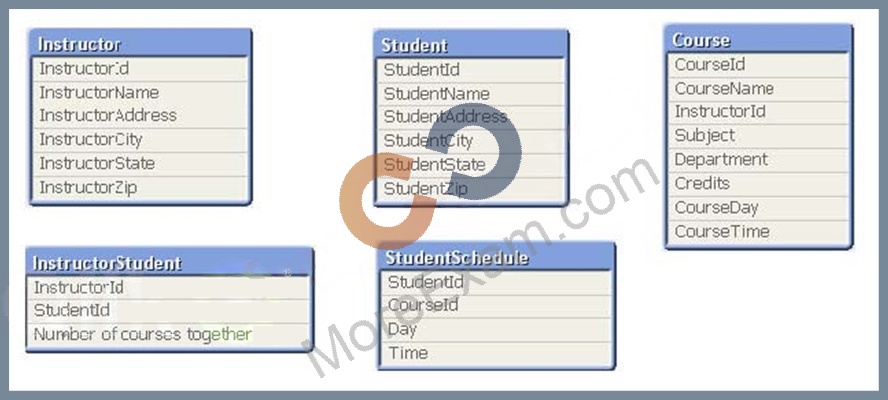
Question11: Refer to the exhibit to the right.

Which technique should be used by a developer to eliminate the circular reference in the data model displayed in the exhibit?

Question12: Refer to the exhibit.

A customer needs to analyze transactions across the Dimensions and Metrics identified below.
Required Dimensions.
------
Project ID Month Year Account ID Transaction Type Client ID
Required Metrics.
-----
Number of transactions Total Amount Total Cost Average Amount Average Cost
Which approach will provide the most effective QlikView data model to meet the customer's requirements while optimizing performance and maintaining accuracy?

Question13: Refer to the exhibit to the right.

What is the cardinality of the relationship between CUSTOMER and ACCOUNT?

Question14: A developer made several changes to a 25-tab load script that normally runs for at least two hours.
Which step should the developer take first to efficiently debug the script logic?

Question15: A customer has 30 target values that are used to evaluate the quality of an organization's facilities. At least half the target values are changed monthly by the business users.
What is the most efficient way for the developer to store, access, and maintain the target values?

Question16: A customer's data set contains information for multiple departments.
The customer needs a document to show only one specific department when a user first accesses the application.
Which trigger and action will meet the requirement?

Question17: Which chart should a designer use to display orders, sales, and average order value grouped by year, quarter, region, product, and salesperson?

Question18: A customer specified that the QlikView application should be designed to fit a screen resolution of 1280 x 800 as a standard.
Which option will assist a designer while creating the user interface?

Question19: Which statement describes a required field characteristics that will ensure QlikView associations across multiple tables?

Question20: A customer is building a dashboard to measure the performance of the Support organization.
The customer needs to dynamically sort the Ticket Severity field by Severity Weight field when the Ticket Severity column header is double-clicked in Straight Table charts.
Example ticket severities. Urgent = 1 High = 2 Normal = 3 Low = 4
Which QlikView load script function can the developer use to create the Ticket Severity field to meet the customer's needs?

Question21: A customer has sales data containing a fact table, Sales and dimension tables, Customer, Item, and Vendor.
After loading the data, the Entity Relationship Diagram (ERD) has a synthetic table containing the fields Name and Address from the Vendor and Customer tables.
How can a developer eliminate the synthetic keys and appropriately link the data?

Question22: A customer needs to produce formatted output as a PDF to distribute it to non-QlikView
users.
Each page should show sales trending for a different sales team.
The number of sales teams will change frequently.
What should a developer create to efficiently enable users to create the required output?

Question23: A developer needs to add data from a Microsoft Access database to a data model intended to run on a 64 bit Windows Server.
How should the developer proceed?

Question24: When should a developer create a new tab in the Load Script?

Question25: How does QlikView link a fact table and dimension table in the associative data model?
Question26: Which action should a developer perform on a table to reduce required memory and optimize the application?

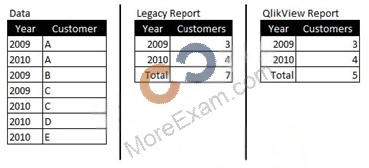
Question27: Refer to the exhibit below.

A QlikView report does not match the legacy report it was designed to replace. The purpose of the report is to count the number of customers per year and in total.
Why is there a difference between the Total row values in the two reports?

Question28: A developer has a Container Object with multiple charts and each chart has many different expressions.
The developer needs to provide users with a method to easily obtain information related to each chart and the expressions within.
How can the developer fulfill this requirement?

Question29: A customer needs a better understanding of inventory trends over time. However, the source database contains only the current product inventory levels.
Which technique will take advantage of QlikView capabilities to meet the customer's needs?

Question30: What is the interpretation of a 98 percent subset ratio in the CustomerID field in an Orders table when the subset ratio of the same field in the Customer table is 100 percent?

Question31: A developer needs to load data for products from a database table and a text file. The database table and text file can be joined by the field ProductID.
The database table contains the master list of all available products. The text file contains additional data fields, but not for all products.
The developer loads the data from the database table first.
The developer needs to load the additional data fields from the text file into the existing table. The resulting table needs to contain the master list of all available products.
Which type of join should the developer use when loading the text file?

Question32: Refer to the exhibit to the right.

When a customer reloads the script displayed in the exhibit, it fails to respond and complete, and displays an error message.
OBJECT OUT OF MEMORY.
How should the developer resolve the logic error in the script?

Question33: A developer needs to modify the data model of a document that consumes 5GB of RAM when opened in memory.
Which type of client should the developer use?

Question34: How can a designer display the field selections that have been made within a chart caption?

Question35: A customer needs to display sales amounts for the current month and a trend of sales over the prior 12 months using a small amount of screen space.
Which chart type should the designer use to meets the customer's needs?

Question36: What must a developer consider when loading a table after the Section Access statement and before the Section Application statement?

Question37: A customer created 20 expressions that will be used repetitively throughout a QlikView application. These expressions could appear in more than 50 objects located on 15 tabs.
How can a developer efficiently apply and maintain these expressions?

Question38: A customer needs to have QlikView deployed to tablet devices.
When creating the QVW application, which two actions must a developer take to meet the customer's need? (Choose two.)

Question39: Refer to the exhibit below.

The tables displayed in the exhibit need to be loaded into QlikView.
How will the data model appear once the load is complete?

Question40: Refer to the exhibit below.

Schema A displayed in the exhibit has been transformed into Schema B.
How can the before and after schemas be described?

Question41: In which two places in the Chart Properties of a Gauge can expressions be entered?
(Choose two.)

Question42: A client has a data set with two tables.
The Customer table has fields CustomerID, AssignedTo, FirstName, and LastName. The
Orders table has fields CustomerID, AssignedTo, Product, and Quantity.
The AssignedTo field holds an employee reference.
Users need to see Customers and Orders by employee.
The employee assigned to the Customer may not be the same as the employee assigned
to the Order.
Which technique should be used in the script to meet the requirement?

Question43: A designer needs to create a chart displaying the number of patients currently checked into a hospital by age group.
What is the appropriate Dimension for the chart?

Question44: Which objects are the most appropriate for setting one or more values for use in a "what-if" scenario?

Question45: A customer has an Addresses table with the fields. CustomerNumber, CustomerName, AddressLine1, AddressLine2, City, StateCode, PostalCode, and CountryCode.
A designer needs to design a chart to show a count of distinct customers in which the customer's CountryCode is US or CA, while ignoring all selections on the Addresses table except the CustomerNumber and CustomerName fields.
How can the designer calculate the required value?

Question46: Which object should a designer use to integrate QlikView with an interactive third-party web service for use in the AJAX Zero Footprint client?

Question47: Refer to the exhibit to the right.

A customer has two databases containing employee data for different regions.
Based on the script displayed in the exhibit, what will be the resulting table schema?

Question48: A customer with a complex chart is experiencing performance issues when the organization's users view the chart without first applying several filters.
A designer needs to place a restriction on the chart so that the users are forced to make a selection before QlikView will calculate and render the chart.
Which common object property can the designer use to accomplish this?